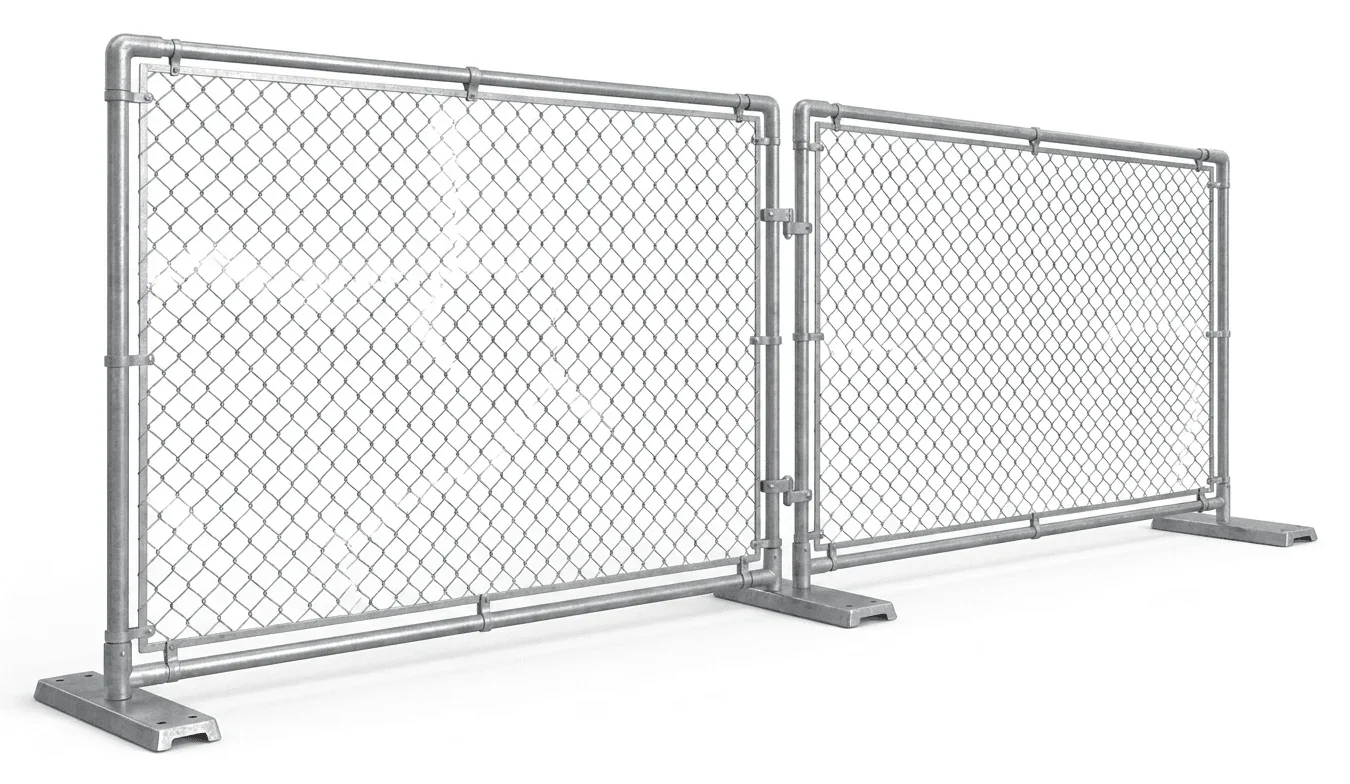
Begin with the boundary line, access points, and surface. Colorado Springs work often spans level slab near logistics buildings and variable grades closer to the foothills. High-wind events and controlled zones influence panel type, site-stability factors approach, and gate planning.
Perimeter layout and access
Where must the line run relative to structures, utilities, and fire lanes?
How many access points are needed for workers, forklifts, and service vehicles?
Are there clear sightlines for security monitoring in high-control areas?
Surface and wind exposure
Slab-on-grade: Standard bases and barricades align well on straight dock aprons.
Mixed terrain: Undulating ground may require shorter panel modules to track grade changes.
Wind: Open fronts along the plains side can funnel gusts. Actual conditions, the equipment’s instructions, and site procedures govern site-stability factors and bracing decisions.
Use cases around local industry mix
Warehousing: Direct pedestrian flow around active forklift aisles and staging zones.
Aerospace-adjacent maintenance: Define high-security work cells with limited visual spill and controlled gates.
Exterior construction on variable soils: Choose panel systems that handle grade while maintaining consistent height for visibility and compliance.
Coordination with lift and material handling
If fencing defines lift work zones on slab, see /electric-scissor-lift-rental/.
For exterior aerial tasks across rough ground, see /rough-terrain-scissor-lift-rental/.
When overhead reach crosses public walk paths, consider barricade lines and spotter corridors; for reach specs see /boom-lift-rental/ and /articulating-boom-lift-rental/.
Measurements and details to prepare
Total linear footage and panel height target
Number and clear width of gates; swing vs. slide
Surface type along the line and the most exposed wind segment
Setbacks from utilities, dock doors, and emergency egress
Equipment questions
Questions about Colorado Springs planning
What fence height works best near logistics buildings?
Many sites favor heights that balance visibility with access control. Confirm any owner or GC standard for panel height before planning gates and corners.
How does the local wind climate affect barricade selection?
On exposed aprons, heavier bases and lower-profile barricades tend to resist shifting better. Final site-stability factors or site-stability planning must align with site procedures and the equipment’s instructions.
Can temporary fencing follow uneven ground in the foothill areas?
Yes, using shorter panel modules or stepped runs can maintain top-line continuity across grade breaks. Capture the steepest segment and any drainage crossings when measuring.